What EN 1991-1-4 does
Eurocode 1 Part 1-4 is the European standard for wind actions on structures. It starts from a basic wind velocity set by each country’s national annex, works through terrain roughness and height to a peak velocity pressure, and multiplies that by shape coefficients to produce design loads for the structure and its cladding. For rectangular buildings and common roofs the coefficients are tabulated and the calculation is routine.
Where the tables stop
The tables cover standard shapes standing alone. A doubly curved roof, a large canopy, a deeply structured facade, or a tower in the wake of another tower are outside them, and interference between buildings can raise local loads well above what the isolated shape suggests. The code acknowledges this and points to wind tunnel testing or properly validated numerical methods for such cases.
The practical consequence for cladding: the sharpest suctions occur in small zones at edges and corners, and generic coefficients there are either unsafe or force heavy over-dimensioning. Both cost money; only one of them fails visibly.
What a CFD loading study delivers
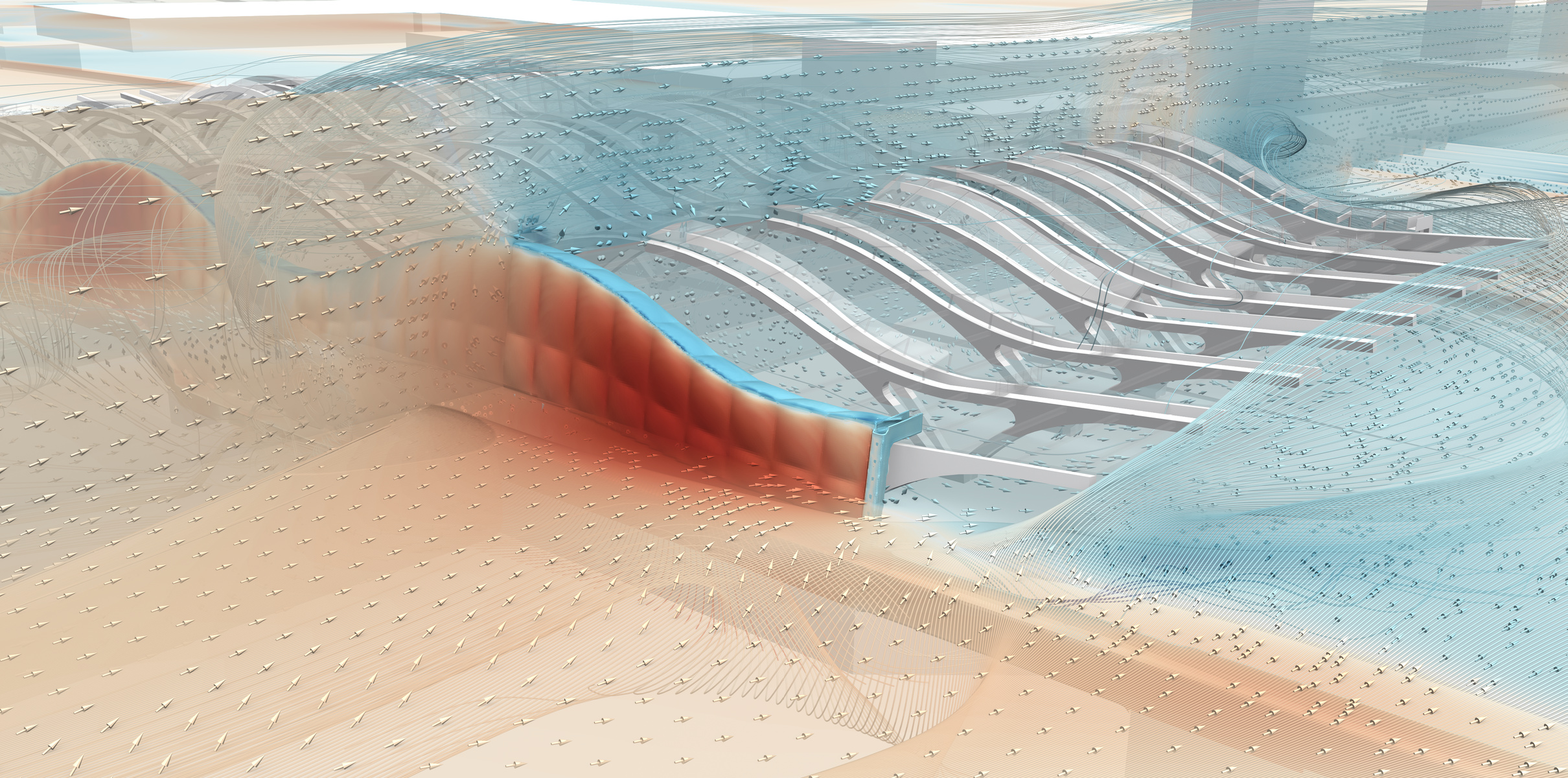
A simulation delivers pressure on every square metre of the envelope, for every relevant wind direction, processed into the same quantities the Eurocode works with so the structural engineer receives loads in a familiar format. Our study of the Mechelen train station canopy for the Belgian railways worked exactly this way: Eurocode-consistent wind climate at the inlet, full geometric detail where the tables stop.
Where this shows up in our work