
Comfort is about how often
People start to find wind annoying when its mean speed at pedestrian height passes roughly 5 metres per second: hair and clothing flap, dust lifts, a newspaper becomes unmanageable. Comfort criteria therefore do not ask how strong the wind can get. They ask how many hours per year a spot is windier than that threshold.
The acceptable frequency depends on the activity. Someone crossing a street tolerates far more wind than someone reading on a terrace, which is why the same location can be perfectly fine for a bus stop and useless for a cafe. Every recognized standard, from NEN 8100 to Lawson, is built on this activity logic.
Safety is about the rare storm
Wind safety uses a much higher threshold, 15 metres per second in NEN 8100. At those speeds people can lose their balance, and for elderly pedestrians or cyclists a fall becomes a real risk. The standard tolerates such conditions only as rare events: between 0.05 and 0.3 percent of hours per year counts as limited risk, and above 0.3 percent the location is classed dangerous, unacceptable near entrances or on required routes.
Comfort problems make a place unpleasant. Safety problems make it a liability, and they concentrate exactly where design attention tends to be lowest: corners, passages and building entrances of tall buildings.
How a study puts numbers on it
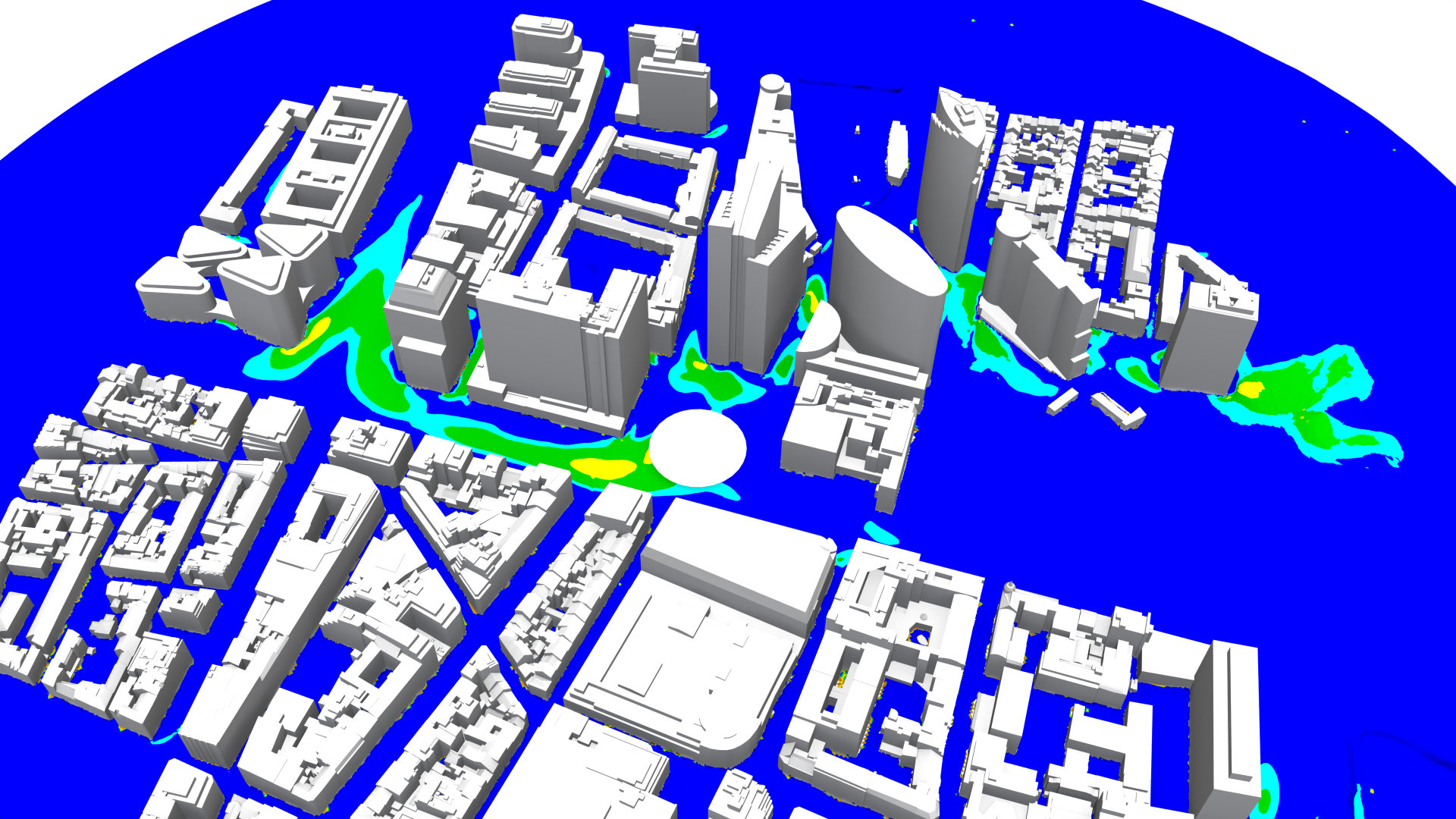
We simulate the neighbourhood in all wind directions and combine the results with decades of meteorological statistics for the site, transformed to local conditions. The result is an exceedance probability for every point at pedestrian height, graded against the applicable criteria and delivered as maps.
For the designer, the value is precision: not "the square will be windy" but "this corner fails for sitting, this one passes, and a 4 metre canopy moves the entrance from grade D to grade B".
Where this shows up in our work