
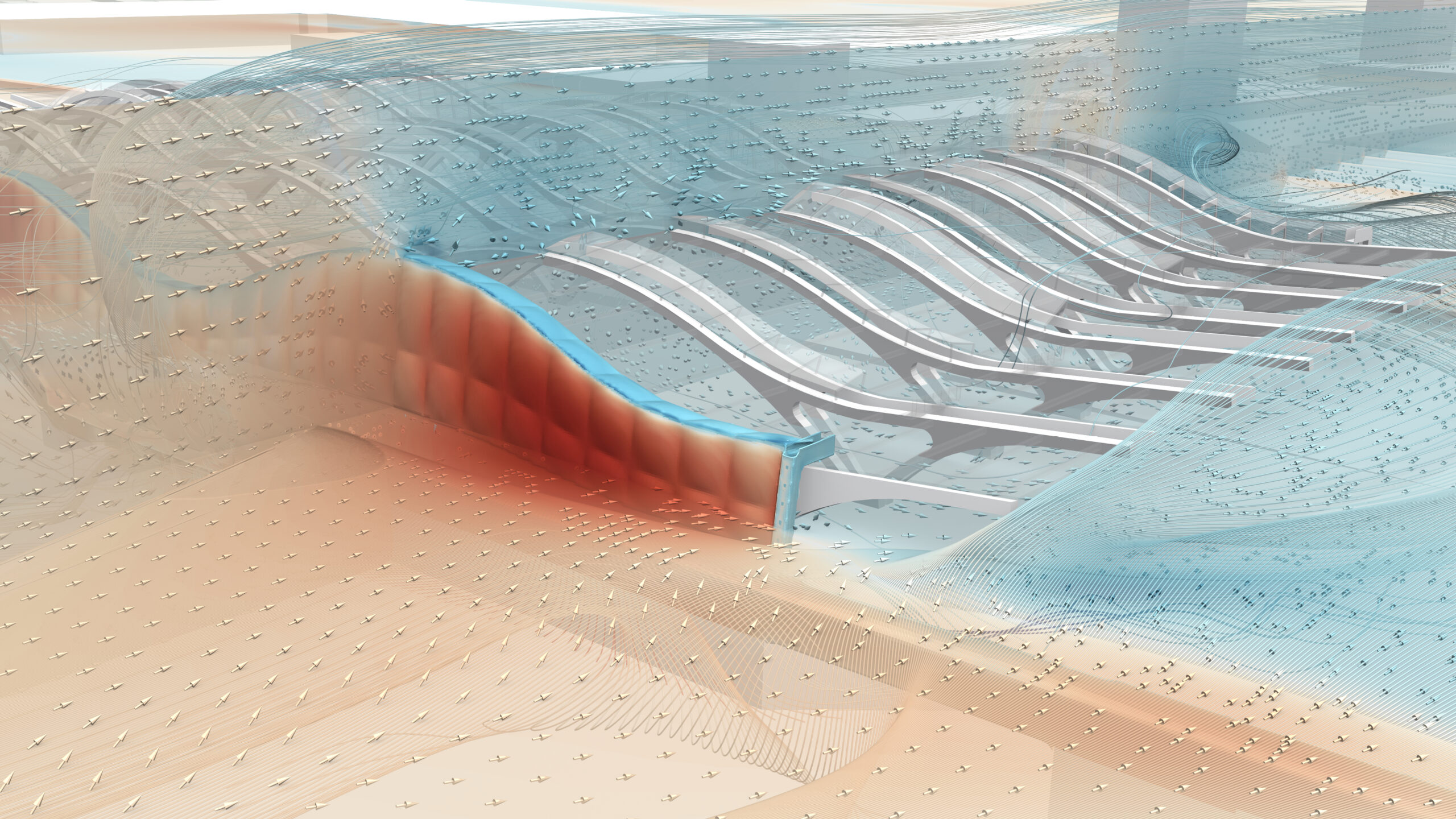
A virtual wind tunnel
Moving air obeys known physical laws. For any real geometry the equations cannot be solved by hand, so CFD solves them numerically: the space around a building is divided into millions of small cells, and a computer works out how air, heat and anything the air carries move through every one of them. The result is a complete picture: wind speed, pressure, temperature and pollutant concentration at every point, not just where a sensor happens to be.
Unlike a physical wind tunnel, the digital model runs at full scale, includes thermal effects and pollutant sources, and can be rerun overnight with a modified design. That last property is what makes it a design tool rather than only a verification tool.
RANS, LES, DNS: three levels of detail
The hard part of the physics is turbulence, which stirs the flow at every scale from hundreds of metres to millimetres. Simulations differ in how much of it they resolve. RANS computes the average flow and models the turbulence; it is fast enough to cover a whole neighbourhood in every wind direction, and it is the workhorse behind comfort and loading maps. LES resolves the larger gusts individually, at a much higher computational price, and is used where the fluctuations themselves matter, for instance wind-induced noise. DNS resolves everything and is reserved for fundamental research.
For a client the relevant point is fit: a study should name the method and why it suits the question. Paying LES prices for a question RANS answers is waste; answering a gust-sensitive question with RANS alone is worse.
How to judge quality
Three fair questions to ask any simulation provider. Is the atmospheric boundary layer at the model inlet based on real, transformed wind statistics? Is the mesh fine enough where the answer lives, at corners, edges and pedestrian height? And has the method been validated against measurements or published benchmarks? Our answers are documented in every report, and part of our validation work is published in peer-reviewed journals.
Where this shows up in our work