Buildings are bluff bodies
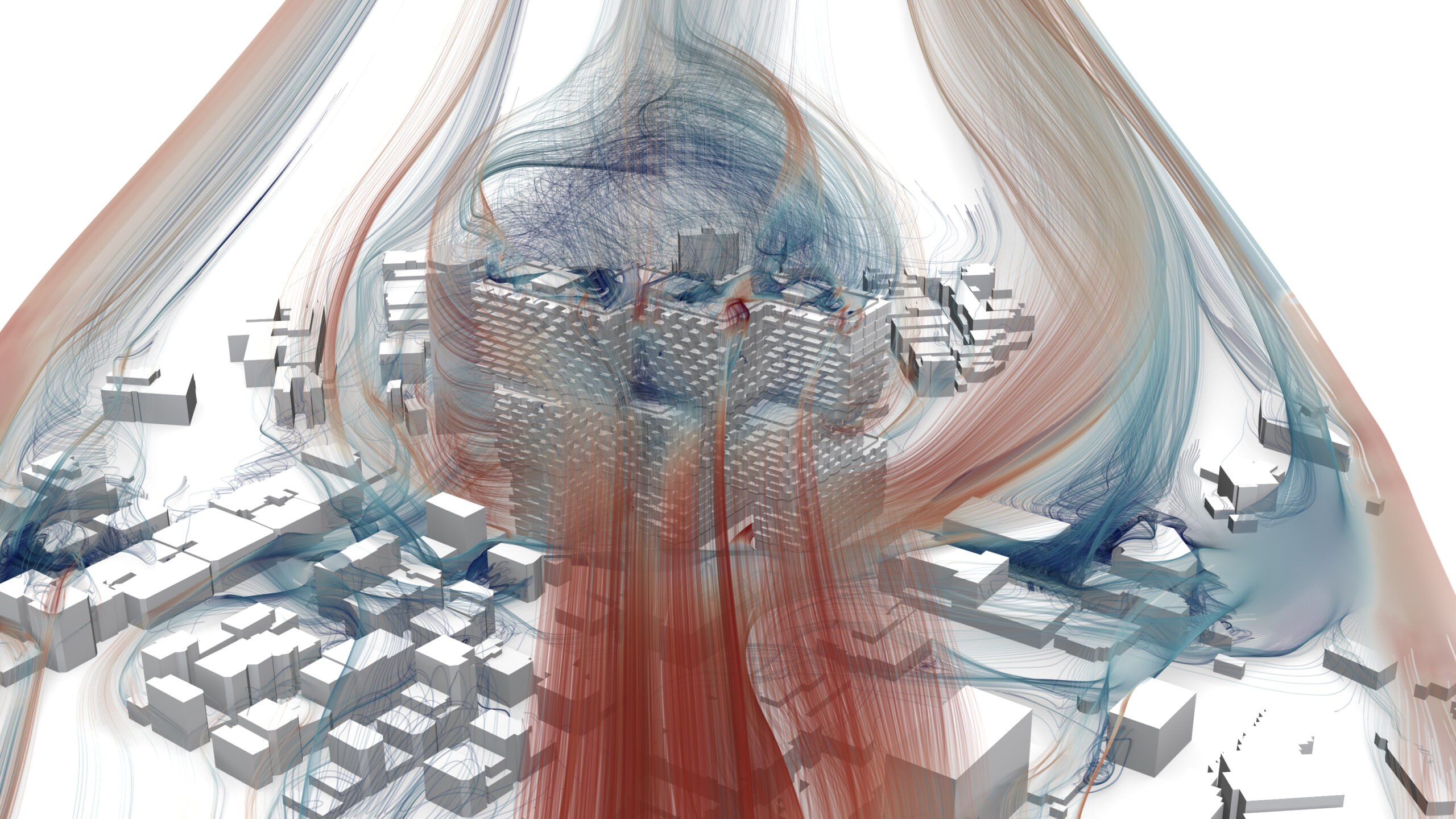
Around a streamlined shape like a wing, air stays attached and follows the surface. Around a bluff body, the flow cannot make it past the sharp edges: it separates, leaving a broad, slow, turbulent wake. Practically every building is a bluff body, and the forces on it come almost entirely from pressure differences between the windward and the separated sides. Shape, not surface smoothness, is what matters.
Separation, vortices, shedding
The shear layers that separate at the edges roll up into vortices. On a tall, slender tower they detach alternately from the two sides, a rhythm called vortex shedding, which pushes the building sideways to the wind and can drive perceptible sway at the top floors. The same mechanics repeats at every scale: parapets, balconies, canopies and cladding fins each generate their own local separations, which is where concentrated loads and wind-induced noise are born.
Why this is good news for design
Because separation is set by geometry, modest moves have large effects. Chamfered or rounded corners weaken corner streams and reduce crosswind forces, which is why supertall towers taper and twist. Porous screens break vortices apart. A podium relocates downwash. The building does not need to look aerodynamic to behave well; it needs the right details in the right places.
This is also why intuition fails so often: the difference between a comfortable plaza and a wind tunnel can be one corner detail. Simulation shows the cause and effect chain before it is built, on your geometry rather than a textbook case.
Where this shows up in our work