
ISO classes, defined
ISO 14644-1 classifies air cleanliness by counting particles per cubic metre at given sizes, each class ten times cleaner than the one above it. ISO class 5, the level typically required over a surgical field or a cleanroom workstation, allows no more than 3,520 particles of half a micrometre or larger per cubic metre; ordinary room air carries millions. Reaching a class is not only a matter of filters: the airflow pattern decides whether filtered air actually protects the critical zone or mixes with the contaminated room air around it.
What a smoke test shows
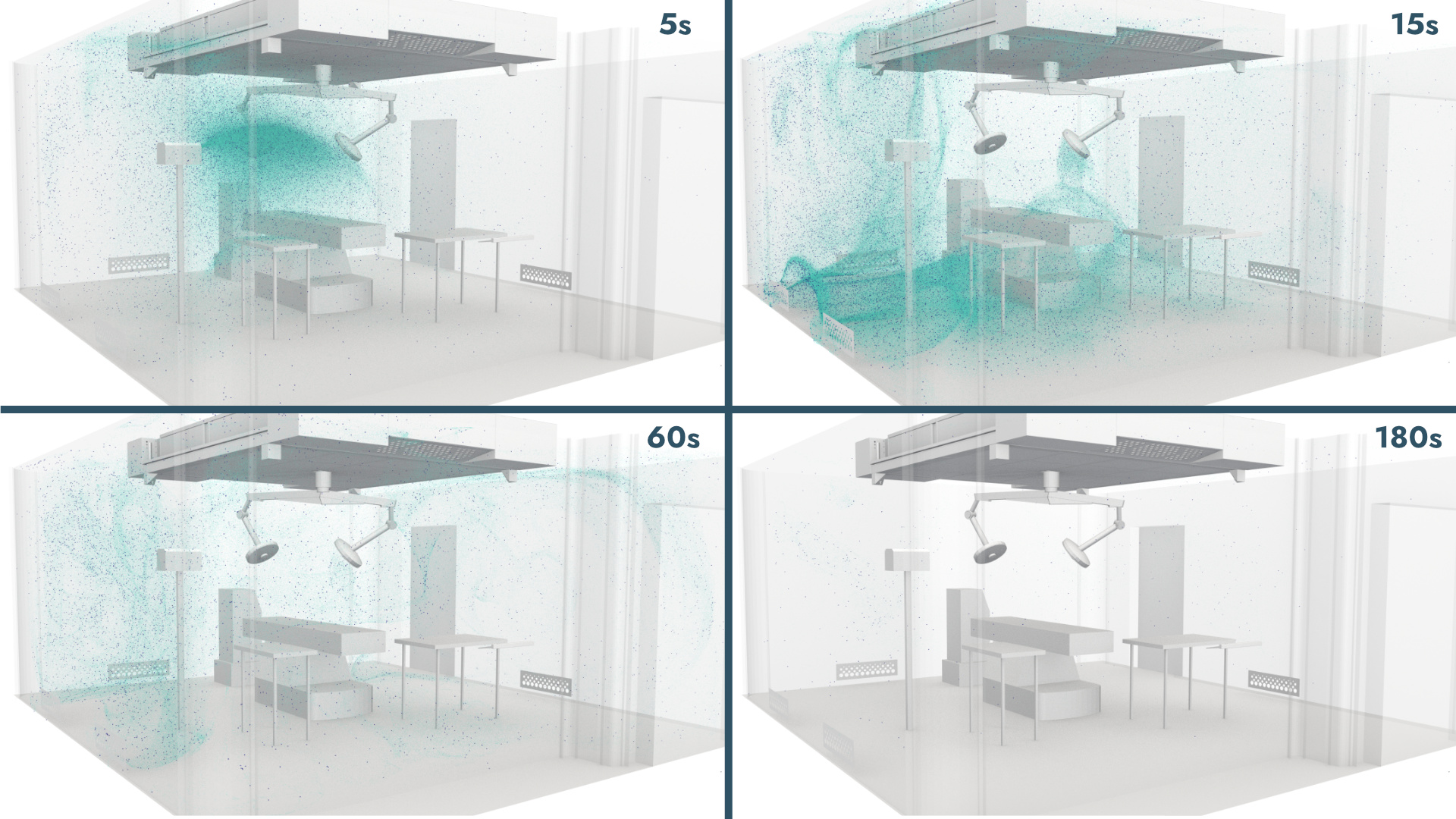
Particle counters give numbers at a handful of points. A smoke test, the airflow visualization of ISO 14644-3, shows the flow itself: whether the unidirectional flow over the table stays unidirectional, where dead zones sit, and how the protective curtain of air behaves around surgical lamps, equipment and staff. The related recovery test measures how quickly a room returns to its class after a contamination event, a direct check of how effectively the ventilation flushes the space.
Running the tests before the room exists
Both tests can be reproduced in simulation long before anything is built: virtual smoke follows the computed flow, and simulated particle releases give recovery behaviour per configuration. Problems that would surface at commissioning, a lamp that splits the clean flow, a return grille that starves a corner, get fixed on the drawing board instead. In our hospital projects in Belgium and Italy the simulations are validated against on-site measurements and smoke tests, so the digital room and the real one can be trusted to behave alike.
Where this shows up in our work