The cube law decides
The power in the wind grows with the cube of its speed: twice the speed, eight times the energy. The rule cuts the other way too: a site with 15 percent less mean wind produces roughly 40 percent less energy. Cities are full of that penalty, because buildings slow the wind exactly where a turbine would stand.
This is why a turbine bought on the strength of airport wind statistics usually disappoints. The airport number describes open terrain; the roof it was installed on does not resemble open terrain at all.
Turbulence, the second enemy
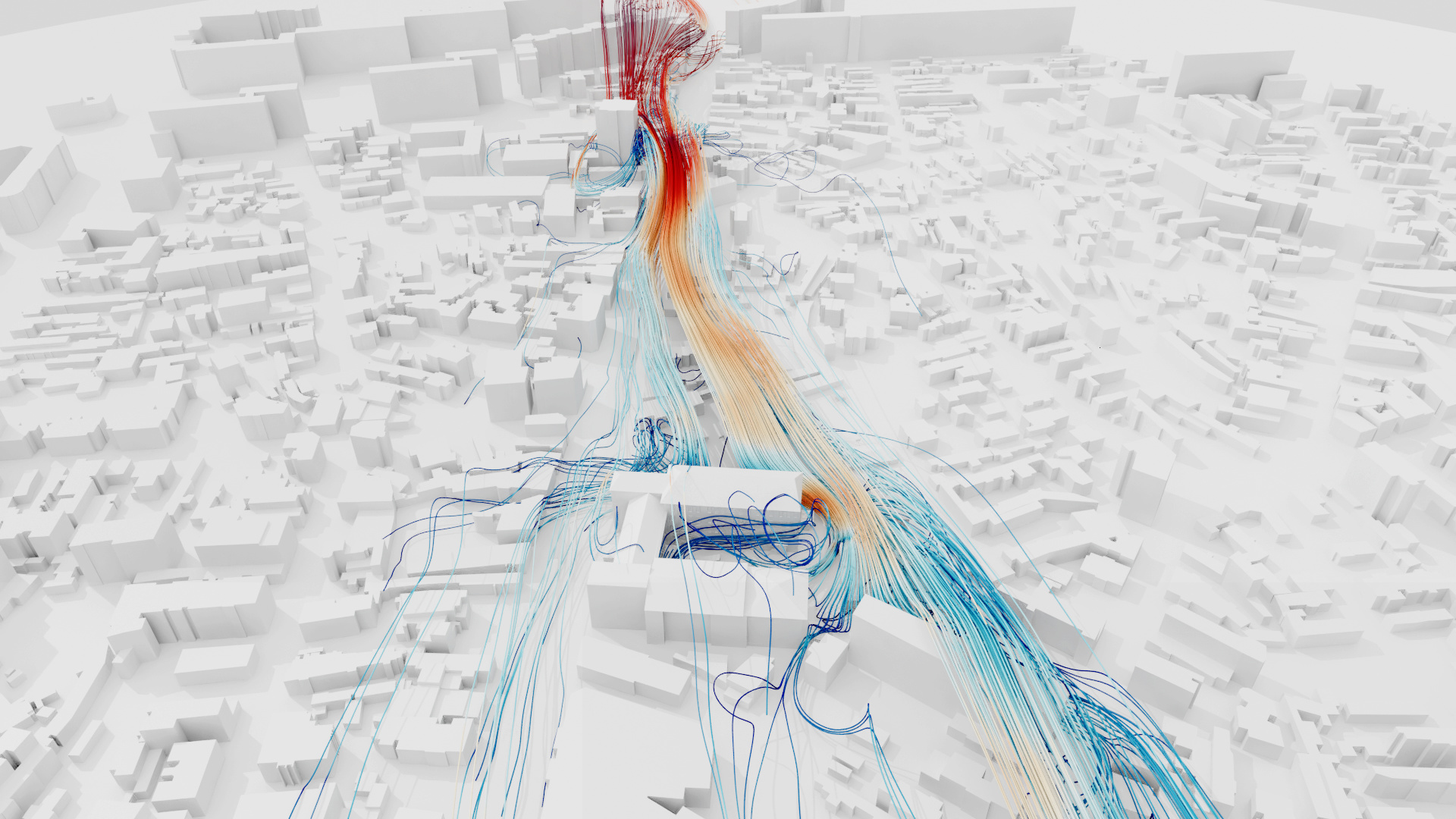
Between buildings the wind is not only weaker, it is gusty and disordered. A turbine in turbulent flow produces less than its power curve promises, wears faster, and makes more noise, a triple penalty that matters to manufacturers as much as to buyers. Smooth, steady wind is worth more than occasionally strong wind, which is why siting above the disturbed zone, well clear of the roof edge recirculation, matters as much as the mean speed.
Finding the sites that work
Good urban sites exist: roofs that stand clearly above their surroundings, edges facing the prevailing wind, coastal and open locations. Our UrbanWind.energy platform exists to find them before money is spent: hundreds of CFD simulations of the real urban geometry, combined with 30 years of meteorological data, produce a realistic annual yield for every candidate location. For a municipality or a manufacturer, that number is the difference between a demonstration project and an embarrassment.
Where this shows up in our work