
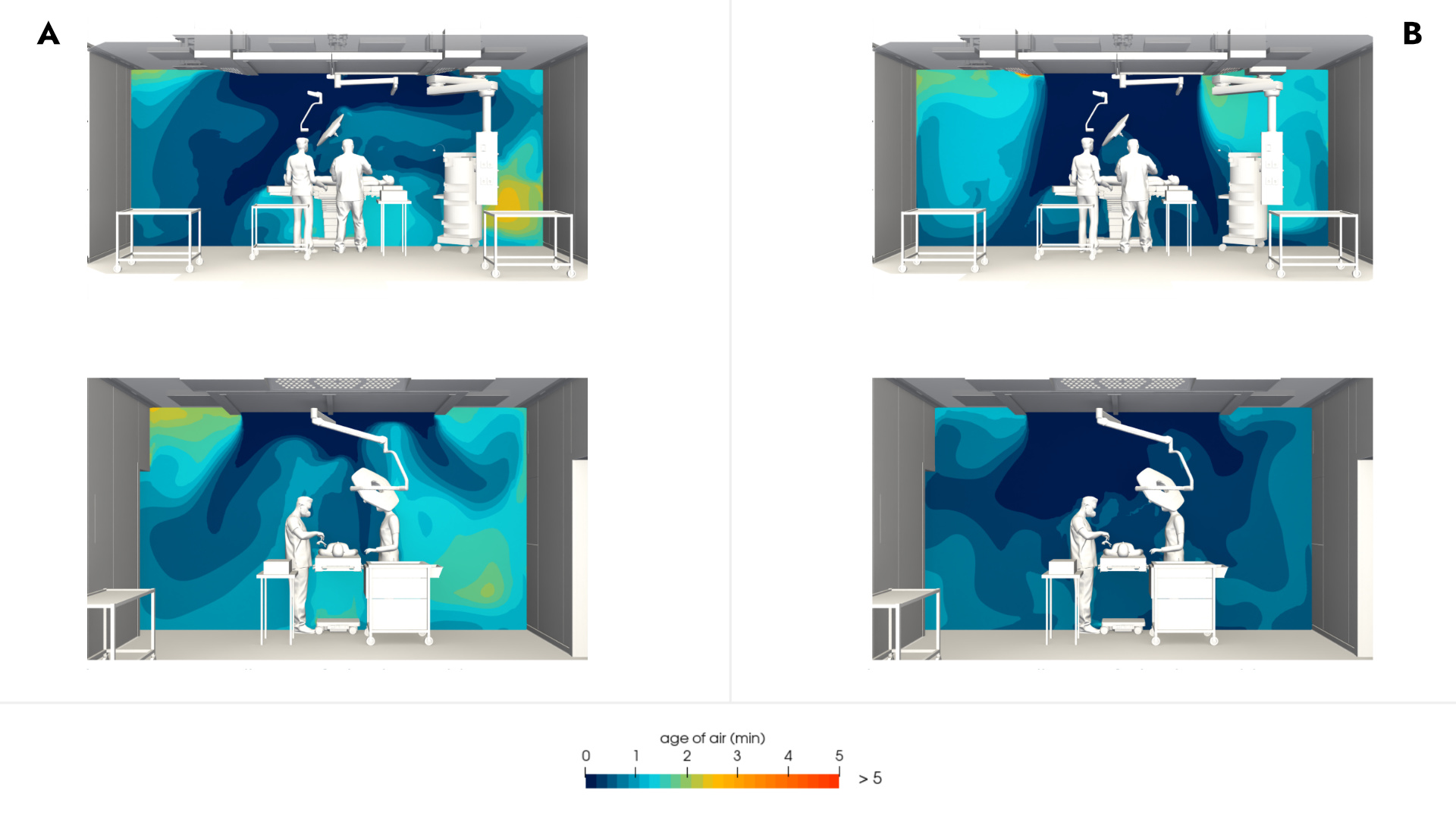
Flow rate is an average
Air changes per hour tell you how much air enters a room, averaged over the whole volume. They say nothing about where that air goes. Supply air can short-circuit straight to the extract, serving the ceiling perfectly while the occupied zone below is barely refreshed, and the flow meter will still report full compliance. This is not a rare defect: it is the default failure mode of ventilation layouts designed on flow rates alone.
What age of air reveals
The local mean age of air is the average time the air at a given point has spent in the room since it came in. Near a supply diffuser the air is young; in a stagnant corner it is old, even when the room as a whole meets its air change target. Computed at every point of a room, age of air turns ventilation from a single average into a map, and the weak spots become impossible to miss, or to argue away.
What to do with it
For a building owner, an age of air map answers the question the flow meter cannot: are the people actually getting the fresh air that is being paid for, including the heating of it? For a designer or an HVAC manufacturer, it compares options: two diffuser layouts with identical flow rates can produce very different maps, and simulating both costs a fraction of installing the wrong one. In our healthcare and indoor air quality projects it is one of the first quantities we compute.
Where this shows up in our work