
A test room that costs nothing to rebuild
Once a product, a diffuser, a filtration unit, a complete airflow system, is modelled and the model validated against one set of physical measurements, every further configuration is a simulation run rather than a rebuilt test room. Different room sizes, ceiling heights, obstacle layouts and thermal loads are explored in software, and the physical lab is reserved for confirming the winner.
We have run this workflow for ventilation manufacturers such as NICFA, whose AIRFLOW system we assessed across operating theatres in Rome, Pisa and Taranto, and for the VIRTUOSO purification system installed at the Ancona university hospital.
Standard tests, simulated
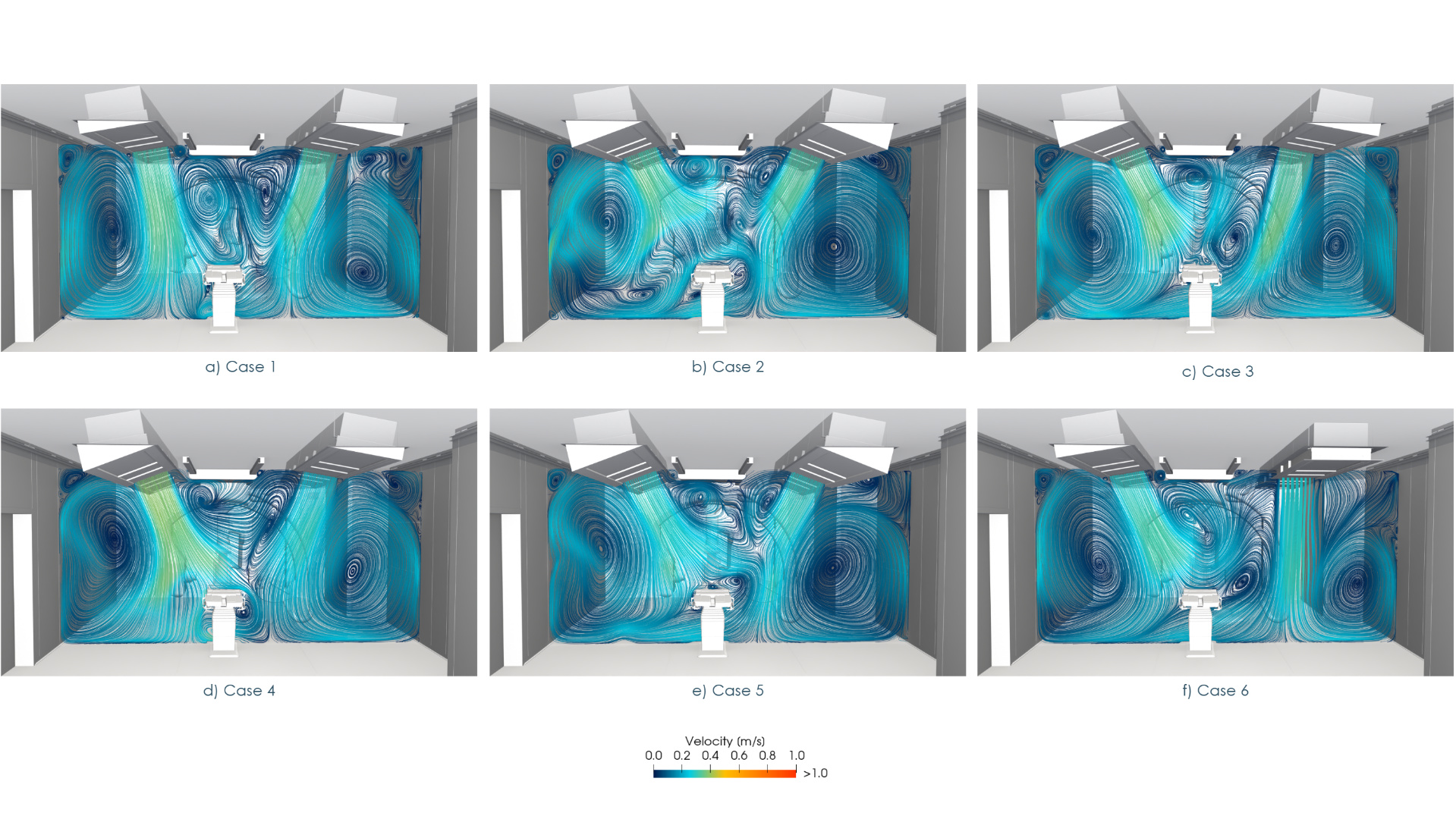
The tests that certify clean environments have digital counterparts. A recovery test per ISO 14644, which measures how fast a room returns to its cleanliness class after a contamination spike, can be simulated for each candidate configuration before any hardware ships. Airflow visualization, the smoke test, has its digital twin in computed streamlines and particle tracks. Running these digitally first means the physical test on site confirms a result instead of discovering a problem.
Evidence that sells
The same simulations produce the material a tender or a technical dossier needs: side-by-side performance comparisons, contaminant removal maps, quantified claims a hospital engineer can check. In a market where every brochure says "superior air distribution", a validated simulation is the difference between an assertion and a demonstration.
Where this shows up in our work