
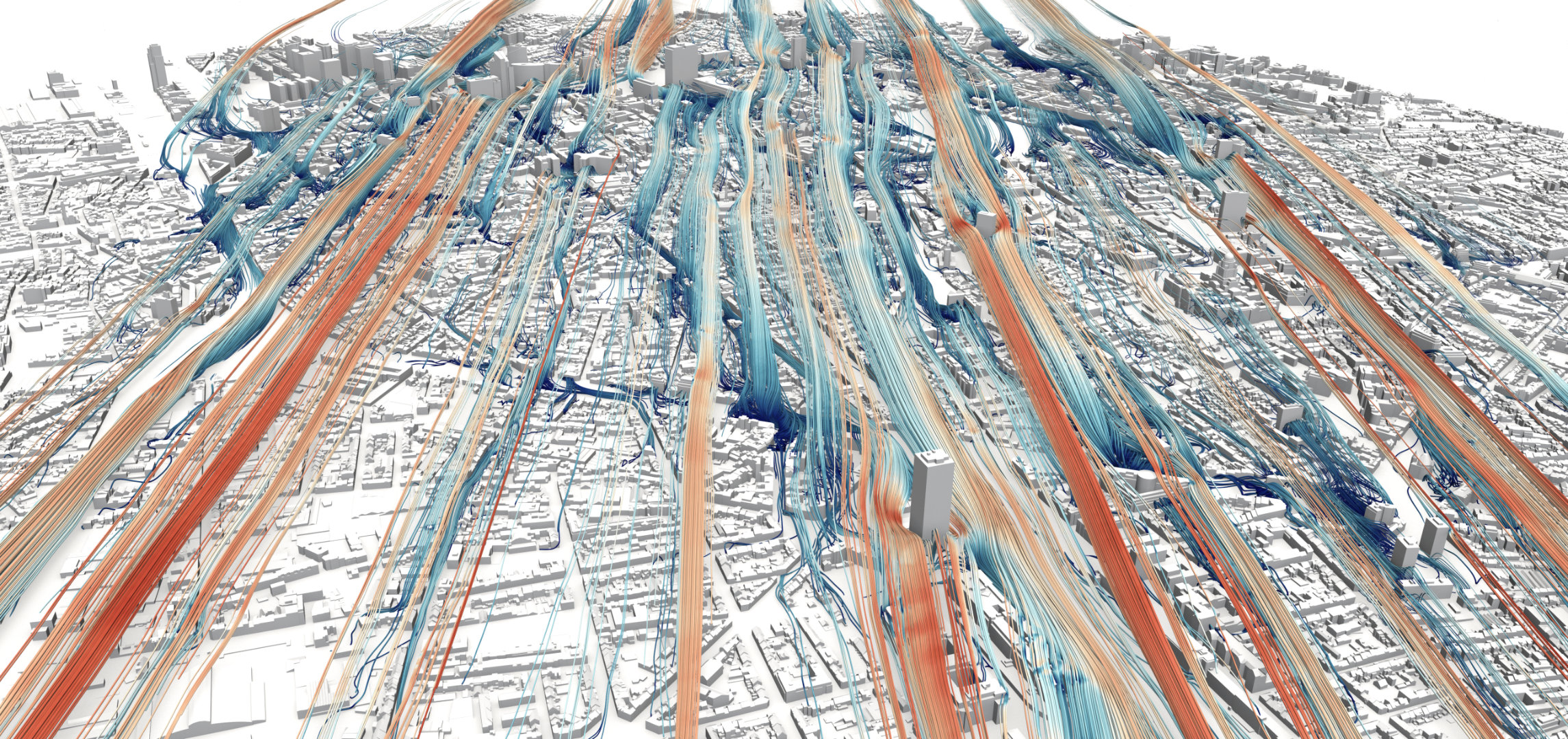
Wind grows with height
The lowest few hundred metres of the atmosphere are slowed by friction with the ground. Inside this layer, wind speed increases with height, quickly near the surface and more gently further up. Every building lives entirely inside it: the top and the base of the same tower stand in genuinely different winds, which is the root cause of downwash and of the wind loads that grow along a facade.
Terrain sets the profile
How fast the wind grows with height depends on what it has been blowing over. Over open sea the profile is steep and the wind near the surface strong. Over a city, full of obstacles, the near-ground wind is much weaker and far more turbulent. Engineers capture this in a single number, the roughness length, which spans from under a millimetre over calm water to more than a metre over a dense city centre.
The consequence for a project: the same regional wind produces very different site winds depending on the approach terrain, and the difference changes with direction. A site can be sheltered from the southwest and exposed to the north.
Why airport data misleads
Meteorological stations measure wind at 10 metres of height in open terrain, typically at airports. Applied directly to an urban site those numbers are wrong in both directions: too strong near the ground, too weak higher up. A serious study transforms the measured wind climate to the site, direction by direction, accounting for the terrain the wind has crossed.
The boundary layer framework we use for this step is published in a peer-reviewed journal and underpins every wind study we deliver. When you compare offers for a wind study, how this step is handled is a fair test of quality.
Where this shows up in our work